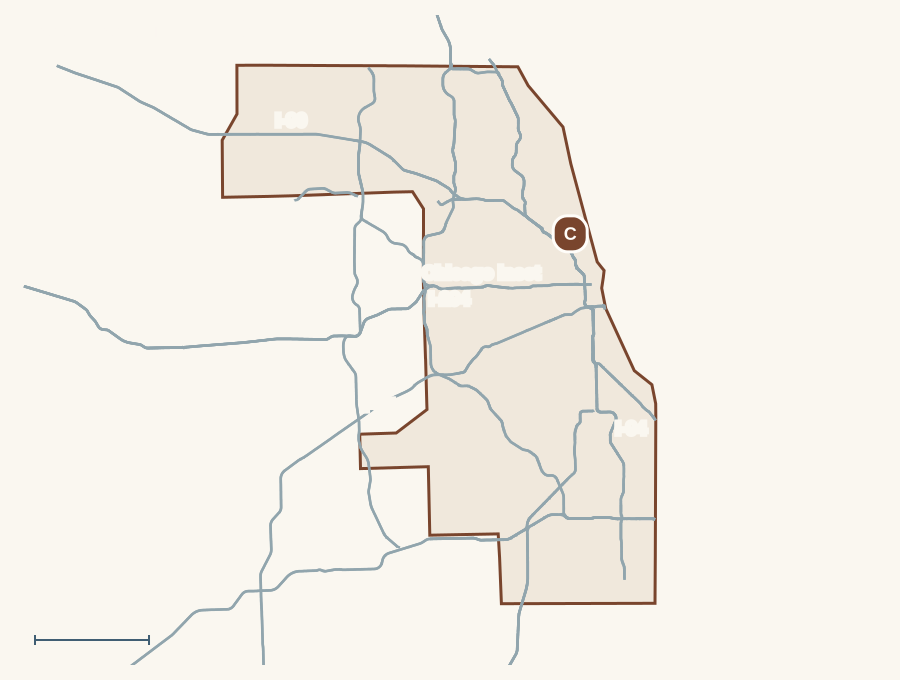
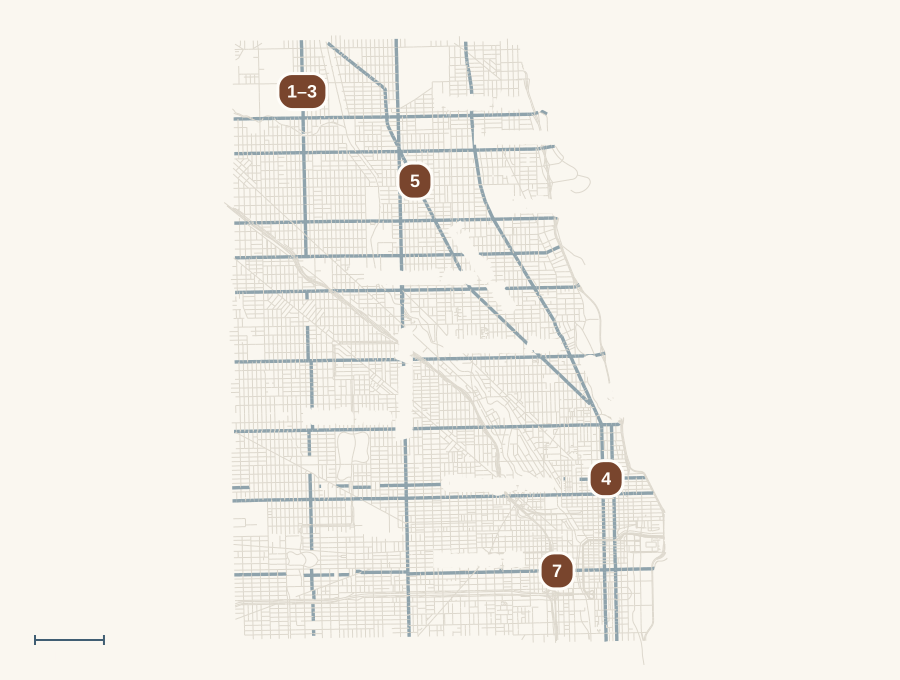
C marks the Chicago area enlarged below. Stops 1–3 share NEIU IRAD. Stop 6 is an online database and has no physical marker. Streets help orient the locations; the key links each marker to its collection and access details.
Open the full-size street map. On narrow screens, swipe across the map. Approximate repository locations, not entrances or walking routes.
Confirm access before visiting. A marker identifies the repository, not the place where a record was created. Appointments, retrieval rules and restrictions still apply. Online collections may include material held elsewhere.
FOLLOW THE RECORD
From a council index to the working papers
STEP 01
Search a subject + year
Use the pre-fire Chicago council index, 1833–1871. Try a street, school or activity as well as a name.
STEP 02
Keep the file reference
Save the result title and complete control number. The index is a pointer, not the whole file.
STEP 03
Request the underlying file
Contact NEIU IRAD by telephone or mail with the control number; ask about copies and attachments.
Evidence check: A petition records a request. Check the decision and related papers before treating it as an action that occurred.
Research-route diagram, not an original record or a completed person search. Based on the linked repository instructions. Checked October 31, 2026.
Sources checked October 31, 2026. Holdings checked against official catalogs and repository descriptions. Staff-confirmed details are identified below; other holdings are based on published sources. No name-level search; dates do not guarantee complete coverage or online images.
STOP 01 / NEIU IRAD
Chicago council working papers: begin with a subject
The official pre-fire index covers 1833–1871. Search a street, school or activity as well as a name, then retain the file control number for a copy request.
A focused question to ask
Can I obtain the file identified by this control number, including attachments and reverse sides?
Evidence limit: An online index entry is not the complete file. The indexed period is narrower than the full archival series.
STOP 02 / NEIU IRAD
Chicago schools: inspectors before the Civil War
These administrative records provide a route to school operations and officials. Start with the school and date rather than expecting a pupil-by-pupil register.
Chicago: School Inspectors’ Minutes 1840–1856 · Accession 7/0019/01
Chicago: School Inspectors’ Expense Journal 1841–1856 · Accession 7/0019/02
Chicago: School Board Minutes 1865–1928 · Accession 7/0049/01
A focused question to ask
Which volume covers this school and year, and is there an index to teachers, buildings or board business?
Evidence limit: Board and inspectors’ minutes are not a substitute for attendance registers. Confirm whether the subject appears before ordering a large run.
STOP 03 / NEIU IRAD
Lakeview: search under the record creator
The holdings database separately lists Lakeview council minutes and their index. Search that municipal name rather than assuming every local record is filed under Chicago.
City Council Minutes (Lakeview) 1857–1889 · Accession 7/0015/01
City Council Minutes Index (Lakeview) 1857–1889 · Accession 7/0015/12
A focused question to ask
Can you check the Lakeview minutes index for this person, street or topic in the specified years?
Evidence limit: The index and minutes are separate series. A council action establishes recorded public business, not a family relationship.
STOP 04 / COMMUNITY COLLECTION
Pullman workers beyond a name in a city directory
Employee indexes and registers (06/02/01) cover 1875–1946. Employee service records (06/02/03) span about 1890–1960, chiefly 1920–1950; Social Security and Railroad Retirement registration files (06/03/04) cover 1937–1960. These are principally operating-company employees, including porters, maids, conductors, shop workers and clerical staff. Service cards can connect a worker with employment dates, addresses and next of kin; some Chicago District cards include photographs.
A focused question to ask
What index or collection reference should I use for this person, place and date, and what access restrictions apply?
Evidence limit: This is not a complete employee census and does not generally cover car-manufacturing or town employees. Medical and disciplinary information has restrictions; mixed files may require screening. A name in an index is a lead to the underlying file, not proof of a family relationship.
STOP 05 / COMMUNITY COLLECTION
Lake View and Ravenswood: reconstruct a neighborhood around an address
The Ravenswood-Lake View Community Collection follows the former Lake View Township into Chicago's Northside communities from the 1860s through the 1990s. More than 100 early photographs depict residents, houses, businesses, schools and everyday activities. Later material includes churches, clubs and neighborhood changes. This is a useful companion to township minutes: it can show the physical setting and local institutions surrounding a family's address.
A focused question to ask
What index or collection reference should I use for this person, place and date, and what access restrictions apply?
Evidence limit: The digital selection is not a comprehensive list of residents. A nearby building does not establish attendance, membership or residence. Check item-level rights and CPL's reproduction policy before republishing images.
STOP 06 / COMMUNITY COLLECTION
Chicago Home for Jewish Orphans: search residents across several kinds of evidence
The Chicago Home for Jewish Orphans operated from 1894 to 1946. JGSI's collection includes 151 graduate and director names from superintendent Leopold Deutelbaum's 1908 booklet, together with transcriptions from the 1900, 1910, 1920, 1930 and 1940 federal censuses. Its more than 780 records can supply a census year, estimated birth year and birthplace. The linked booklet also provides photographs and institutional context.
A focused question to ask
What index or collection reference should I use for this person, place and date, and what access restrictions apply?
Evidence limit: This is an index assembled from selected sources, not a complete admission register or resident case-file collection. Short stays between census years may leave no entry here. Absence does not exclude residence, and an institutional label alone does not establish a child's family circumstances.
STOP 07 / COMMUNITY COLLECTION
Closed Catholic schools and orphanages: request directory information, not an unrestricted file
The archives holds records of approximately 400 closed Catholic schools and named orphanage collections, including Angel Guardian client files and St. Mary's Training School admittance registers. Dates vary by institution and must be checked in the holdings list. Genealogical information may identify attendance, admission or discharge dates, an address or parish. For related sacramental research, the archives directs users to Illinois, Chicago, Catholic Church Records, 1833–1925 on FamilySearch; individual registers have narrower coverage.
A focused question to ask
What index or collection reference should I use for this person, place and date, and what access restrictions apply?
Evidence limit: Student files remain restricted even after death; directory information is a separate request. Orphanage case files and genealogical summaries have different eligibility rules. Researchers are not granted access to originals. Confirm current fees and the institution's exact surviving dates before ordering.
IRAD is an Illinois Secretary of State program administered by the Illinois State Archives. Depository location: Northeastern Illinois University, Chicago. Direct IRAD research requests to the regional depository, not the university’s separate archives or special collections.
IRAD is a separate department from NEIU University Archives. University Archives staff confirmed telephone contact Monday through Friday, 9 a.m. to 4 p.m., on October 29, 2026; confirm current availability before visiting. For IRAD copies, request by telephone or mail to Ronald Williams Library, Northeastern Illinois University, 5500 N. St. Louis Ave., Chicago, IL 60625-4699. The State Archives instructions do not offer email requests. Confirm appointment and copying arrangements before visiting.
Start with no more than two names, approximate dates, the county and the record type. Include the township or school where known and the accession number above. Ask whether an index exists, which volumes survive and what copying will cost. For an unindexed series, agree on a manageable search before requesting a long period. The statewide policy directs research requests to telephone or mail rather than email; wait for a response before sending another request. See the statewide research policy ↗.
Request template: I am researching [person or place] in [locality] around [years]. Your catalog lists [title], accession [number]. Which volume covers that period, is it indexed, and how can I consult or obtain the relevant pages? Please let me know any gaps, restrictions and copying charges.
Collection dates at a glance
The table lists IRAD series with verified date spans. Community collections above may have different or unspecified coverage and separate access rules. Catalog spans are starting points, not guarantees of every year, locality or individual. Use the Research Planner to compare your years with these cataloged series.
Selected cataloged series for Cook County
Record series
Catalog dates
Accession
Chicago: School Inspectors’ Minutes
1840–1856
7/0019/01
Chicago: School Inspectors’ Expense Journal
1841–1856
7/0019/02
Chicago: School Board Minutes
1865–1928
7/0049/01
City Council Minutes (Lakeview)
1857–1889
7/0015/01
City Council Minutes Index (Lakeview)
1857–1889
7/0015/12
Keep the record and your interpretation separate.
Save the depository, collection, accession number, volume, page, dates and any copy correspondence. Record uncertain names as uncertain. A shared road, school or signature can suggest an association; it does not establish a family relationship.
Suggest a correction, an overlooked collection or an updated access detail. An official link or source helps us check it before making a change. Please leave out private family documents and sensitive personal information.
Selected roads are shown for orientation. One-way restrictions, current construction, entrances and township boundaries are not shown. Map prepared October 31, 2026.
Share this county guide
Know someone researching here? Share this to help them find their next source.