A roster can name the person. Minutes, annual reports and appointment notices can explain the work. Follow the office into its records, including women’s public service before 1920.
By Jeremy VanMeter · Sources and original report pages checked November 3, 2026.
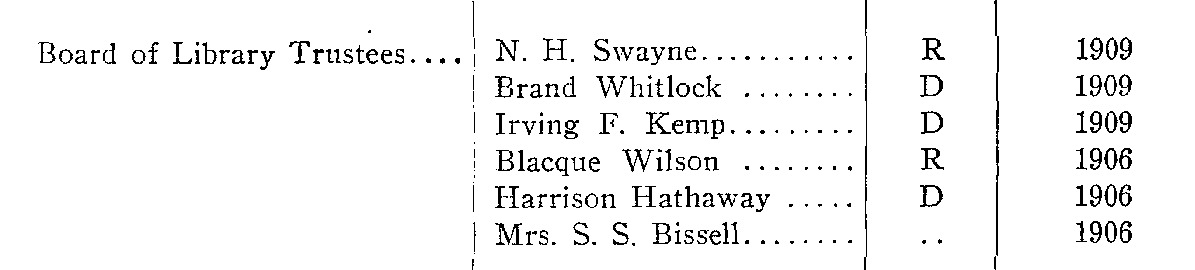
A clue, not a finished identification: Mrs. S. S. Bissell in the 1903 roster, printed page 62.
WATCH THE RESEARCH IN ACTION
Your ancestor in public office
Follow the Ohio rosters and library reports, including women’s service before 1920 and the Bissell initials discrepancy.
Search for Ohio Roster of Municipal and Township Officers and Members of Boards of Education, adding the year and community. The 1903 volume on Google Books ↗ provides our Toledo example. This is a local-officer series, not a military roster; editions covering state and county officers may have different scope.
Open the volume and check its title and year. Search the town or township first, then the surname and variants.
If the search fails, browse the community’s section. OCR can miss names, initials and column layouts.
Save the full page and citation, including the office, jurisdiction, printed page and column headings. A viewer’s image number may differ from the printed page.
Compare nearby editions where available. A term-expiration column is not a first-appointment date, and absence from the next edition does not prove death or a move.
Access: Use the page viewer and its search controls. If an edition is unavailable there, search the exact title in Internet Archive or a library catalog, then ask about a scan or reading-room copy. Preview and download availability vary by edition. This guide does not claim every year survives online.
THE OFFICE AND THE YEAR MATTER
Women could serve before full suffrage.
Ohio school boards, 1894
Ohio’s 1894 school-suffrage law allowed women to vote for school-board members and seek those positions. This was a limited right, not the right to vote in every election. The legal distinction concerned legislative authority over public schools and eligibility for those offices.
Ohio History Connection’s account ↗ documents Pauline Perlmutter Steinem’s election to Toledo’s school board in 1904 and a term beginning January 2, 1905, citing the board manual. The Capitol Square Foundation ↗ dates Harriet Taylor Upton’s election to Warren’s board of education to 1898.
Do not apply a school-board election law to a library board simply because both serve the community. Municipal libraries, school-district libraries and private associations can have different governing arrangements.
Determine whether the position was elected or appointed, then locate the institution’s rules for that period. Voting eligibility and eligibility to serve are separate questions.
WORKED EXAMPLE • TOLEDO PUBLIC LIBRARY
Three entries. An initials discrepancy worth keeping.
These are crops of the original pages, not AI reconstructions. Select a crop to open it at a larger size; use the source links to inspect its context.
1903 ROSTER
Mrs. S. S. Bissell
The Toledo library-trustee entry gives a term expiration of 1906.
Assessment: a strong correlated identification, with a discrepancy retained.
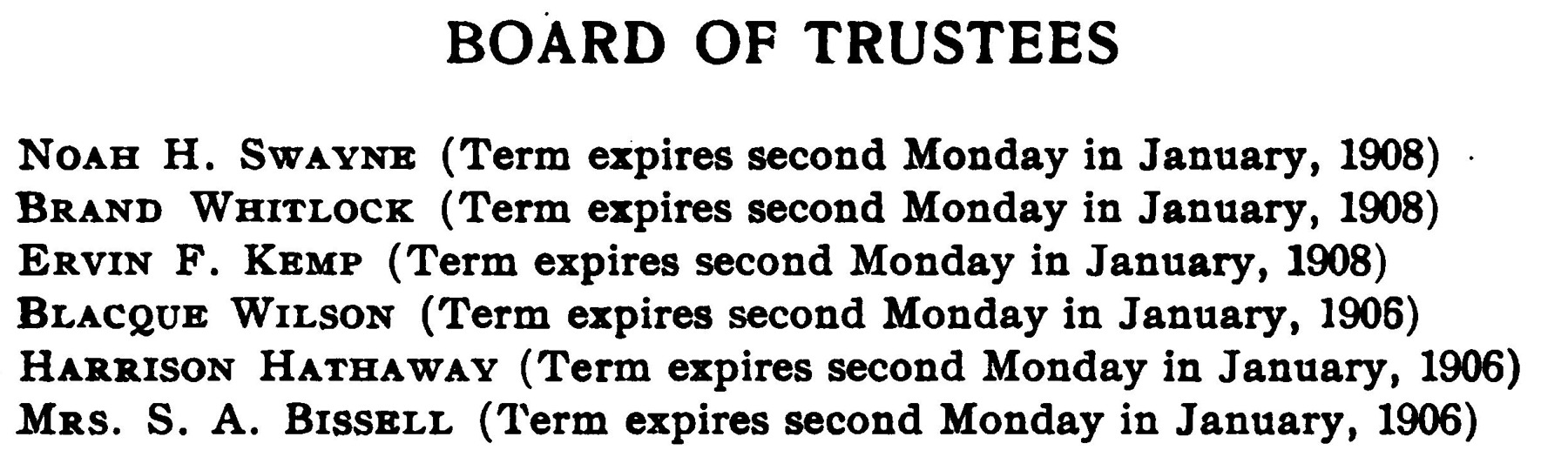
The institution, board context and matching 1906 term expiration strongly connect the roster entry with Sarah A. Bissell. They do not justify silently changing “S. S.” in a transcription. Preserve each reading and cite the evidence supporting the connection. Do not assume a married woman’s initials necessarily belonged to her husband.
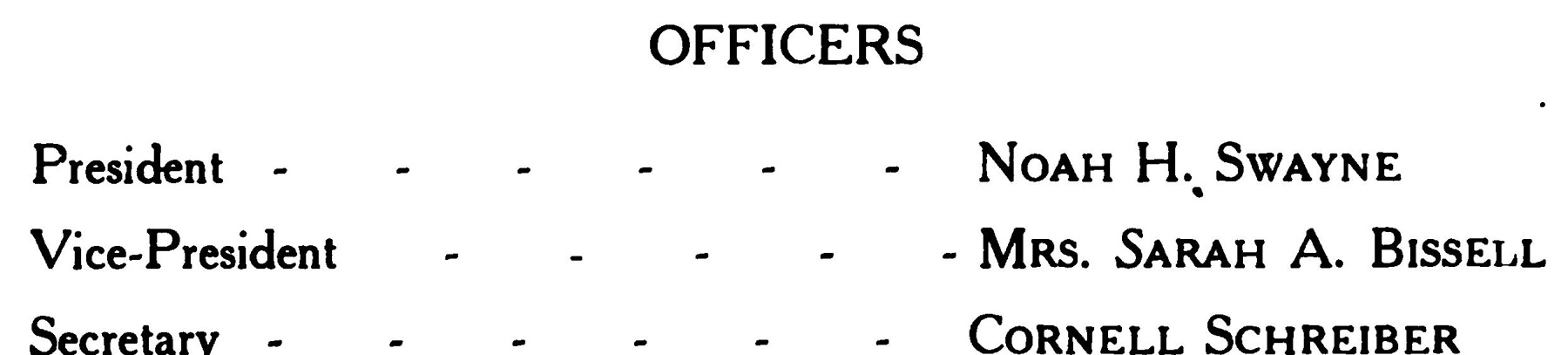
The 1904 report also shows responsibility: Bissell chaired the reading-room committee. Elsewhere on the same page she appears on circulation and laws-and-regulations committees. Inspect the full committee page ↗.
What remains unresolved?
Her original appointment notice, first appointment date and the authority that selected her have not been established in this research. A later survey covering 1914–1918 describes mayoral appointments to four-year terms. That is evidence for the later system, not proof of Bissell’s original appointment.
Reading the compilation: Internet Archive groups multiple annual reports in one item. Check the individual report’s title page and year, not just the item’s catalog date. The report for 1904 was published in 1905; the report for 1906 in 1907. Image numbers above are viewer locators, not printed page numbers.
TURN THE CLUE INTO A RESEARCH PLAN
Follow the office into the next record.
Place + year
Identify the municipality, township, school district or institution. Compare boundaries and earlier names; a modern county label may not describe the original record creator.
Office + rules
Was the role elected, appointed or internal to an association? Seek the charter, statute, bylaws or ordinance in force then. Do not infer the selection process from a job title.
Records + custodian
Look for council or board minutes, annual reports, election returns, appointment notices and committee papers. Start with the current clerk or institutional archives, then ask the local library or historical society about transferred records.
Person + evidence
Compare residence, occupation, relatives and other dated records. Keep same-name people separate until the evidence supports a connection. Record unsuccessful searches as well as discoveries.
A focused repository question
“I found [name as printed] listed as [office] in [community and year], [title and page]. Do you hold board or council minutes, appointment notices or annual reports for [specific years]? If not, do you know the current custodian? Please let me know about indexes, access restrictions, appointments and copying charges.”
Survival and access vary. An annual report may describe a board without preserving its minutes; a catalog date span does not guarantee every year or person appears.
The linked roster and Toledo report pages above are the primary evidence for the Bissell example. The school-board examples rely on the linked institutional histories; we do not claim to have inspected their cited original board manual. The historical suffrage account and later court discussion provide context, not a complete legal history of every Ohio office.
Record the creator, title, report or volume year, printed page or viewer image number, stable link and access date. Separate the source’s wording, your interpretation and the next unresolved question.
Have a correction or a surviving local-officer collection to suggest? Send a guide correction.
HELP KEEP THIS GUIDE USEFUL
Know a collection we should include?
Suggest a correction, an overlooked collection or an updated access detail. An official link or source helps us check it before making a change. Please leave out private family documents and sensitive personal information.